Jane Eyre
Jane Eyre is the protagonist and first-person narrator of Charlotte Brontë's novel, an orphaned governess whose journey from an abusive childhood to a hard-won marriage with Edward Rochester traces a moral and emotional arc defined by her insistence on self-respect, equality, and integrity. Her voice—at once passionate, introspective, and fiercely independent—anchors the narrative and gives the book its enduring power as a story of a woman who claims her own worth against every form of oppression.
Identity and Background
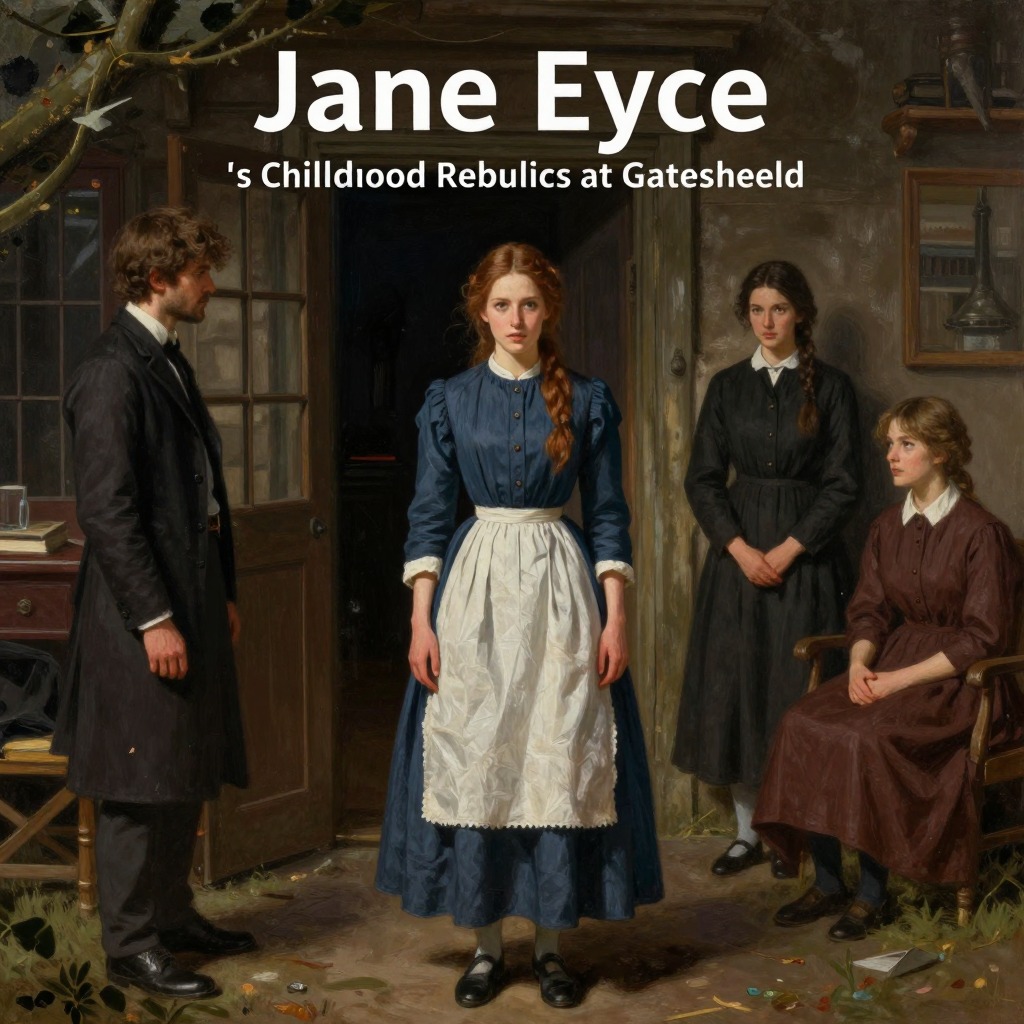
Jane is introduced as a ten-year-old orphan living at Gateshead Hall, the home of her aunt, Mrs. Reed. Her parents, both dead within a month of each other, were a poor clergyman and a woman who married against her family's wishes; her father died of typhus contracted while visiting the poor, and her mother died of the same infection. Jane's earliest memories are of being told she is a dependent, a burden, and less than a servant. She describes herself as a "discord" in the household, a "heterogeneous thing" opposed to the Reeds in temperament and capacity. Her physical appearance—small, pale, with irregular features—becomes a recurring motif, one she herself acknowledges with a mixture of regret and defiance. She is acutely conscious of her plainness, yet she refuses to let it define her value.
Life and Plot Trajectory
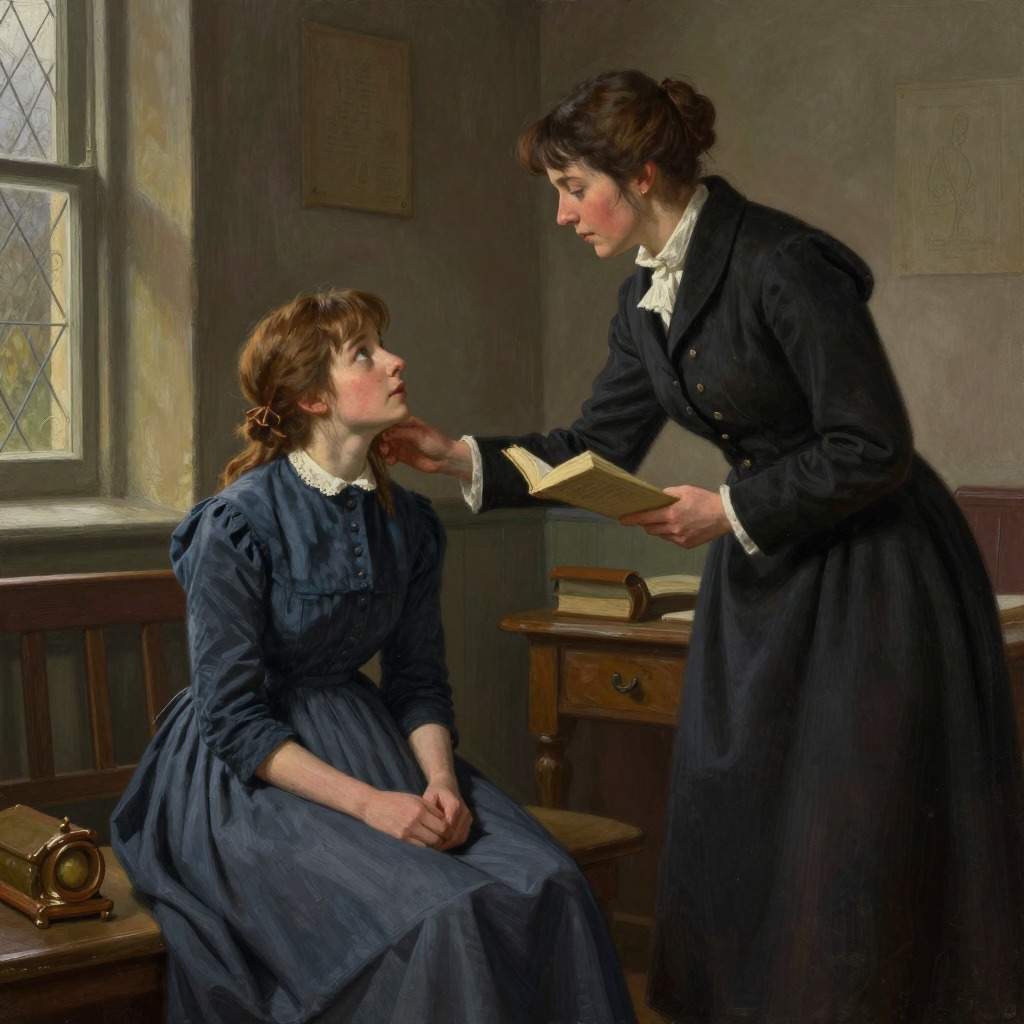
Jane's life unfolds in a series of distinct phases, each a test of her principles. At Gateshead, she endures the bullying of her cousin John Reed and the cold hostility of Mrs. Reed, culminating in her imprisonment in the red-room, where she suffers a fit of terror and unconsciousness. This incident prompts the apothecary Mr. Lloyd to recommend her removal to school. She is sent to Lowood Institution, a charity school run by the hypocritical Mr. Brocklehurst, where she endures harsh conditions—burnt porridge, inadequate clothing, and public humiliation. There she forms a crucial friendship with Helen Burns, whose doctrine of Christian endurance contrasts with Jane's own fiery sense of injustice, and she finds a mentor in Miss Temple, the superintendent who clears Jane's name after Mr. Brocklehurst denounces her as a liar. After eight years at Lowood—six as a pupil, two as a teacher—Jane grows restless and advertises for a position as a governess. She is hired by Mrs. Fairfax at Thornfield Hall to teach Adele Varens, the ward of Mr. Rochester.
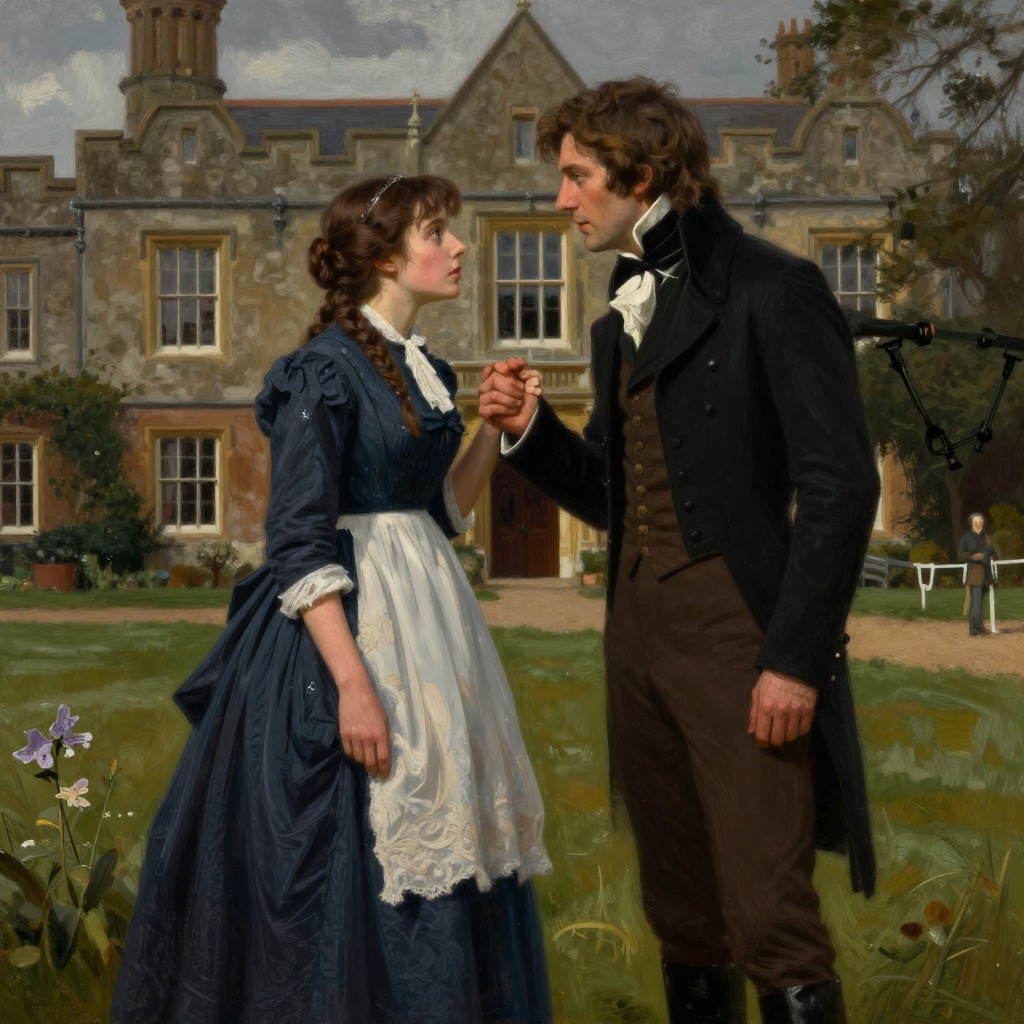
At Thornfield, Jane's life deepens. She meets Mr. Rochester in a memorable encounter on Hay Lane, where she helps him after his horse slips on ice. Their relationship develops through a series of intense conversations in which Rochester draws out her mind and spirit, and Jane, despite her awareness of their difference in rank, finds herself falling in love with him. She saves his life when his bed curtains are set on fire—an act that cements their bond. When Rochester feigns courtship of Blanche Ingram to provoke Jane's jealousy, she resolves to control her feelings, painting a miniature of the imagined Blanche and a self-portrait as a reminder of her own plainness and poverty. Yet Rochester eventually proposes, and Jane accepts, believing herself loved as an equal.
The wedding is interrupted by the revelation that Rochester is already married to Bertha Mason, a madwoman confined to the third storey of Thornfield. Jane, though she still loves Rochester, refuses to become his mistress and flees the house in the middle of the night, with only twenty shillings and a small parcel. She wanders for days, nearly starving, until she is taken in by the Rivers family at Moor House. There she recovers, assumes the alias Jane Elliott, and becomes the village schoolmistress at Morton. She discovers that St. John Rivers, Diana, and Mary are her cousins, and that she has inherited twenty thousand pounds from her uncle John Eyre. She divides the fortune equally among the four of them.
St. John, a cold and ambitious clergyman, proposes marriage, asking Jane to accompany him as a missionary's wife to India. She refuses, recognizing that he does not love her and that such a union would be a form of spiritual death. In a moment of crisis, she hears Rochester's voice calling her name across the distance—a supernatural summons she answers by returning to Thornfield. She finds the house burned down, Bertha dead, and Rochester blinded and crippled. She reunites with him at Ferndean Manor, and they marry. The novel concludes with Jane's account of ten years of married happiness, Rochester's partial recovery of sight, and the birth of their first son.
Key Actions and Objectives
Jane's defining actions are driven by a consistent moral compass. As a child, she strikes back at John Reed after he throws a book at her, crying out that he is "like a murderer—like a slave-driver—like the Roman emperors." She confronts Mrs. Reed directly, declaring, "I am not deceitful: if I were, I should say I loved you; but I declare I do not love you." At Lowood, she endures Mr. Brocklehurst's public denunciation without breaking down, sustained by Helen Burns's smile. She decides to advertise for a position, a bold act of self-reliance for a young woman of her station. She saves Rochester from the fire in his room, an act of courage that also reveals her growing attachment. Her most crucial action is her flight from Thornfield after the interrupted wedding: she leaves not because she has stopped loving Rochester, but because she will not compromise her principles. "I care for myself," she tells him. "The more solitary, the more friendless, the more unsustained I am, the more I will respect myself." She refuses St. John's proposal for the same reason, recognizing that a marriage without love would be a violation of her integrity. Her return to Rochester is an act of choice, not desperation: she is now financially independent and can come to him as an equal.
Relationships and Conflict
Jane's relationships are the crucible in which her character is forged. With Mrs. Reed, she experiences rejection and injustice, but she also learns to forgive: at Mrs. Reed's deathbed, she offers reconciliation, though it is refused. With Helen Burns, she finds a model of spiritual fortitude and learns that "life appears to me too short to be spent in nursing animosity or registering wrongs." With Miss Temple, she experiences kindness and intellectual stimulation, and she credits her with the best part of her education. With Adele, she is a patient and affectionate teacher, refusing to abandon the child even after learning of her mother's history. With St. John Rivers, she is drawn into a conflict between duty and desire: she respects his dedication but resists his cold, instrumental view of marriage. Her relationship with Rochester is the novel's central drama. It is marked by intense intellectual and emotional communion, but also by power imbalances and deceptions. Jane insists on equality: "I have as much soul as you,—and full as much heart!" When Rochester proposes a life together outside marriage, she refuses, even though it breaks her heart. Their reunion at Ferndean is a union of equals: Jane is now financially independent, and Rochester, blind and crippled, is dependent on her care. She becomes his "vision" and his "right hand," and their marriage is described as a perfect concord.
Change and Ending
Jane's arc is one of progressive self-possession. She begins as a powerless, angry child, moves through the discipline of Lowood, and emerges as a young woman capable of both passionate love and principled renunciation. Her inheritance gives her the economic independence that makes her final choice truly free. The ending is one of deep fulfillment: she marries the man she loves, and their life together is described as a state of "perfect concord." Rochester recovers the sight of one eye, enough to see their first-born son, who has inherited his father's "large, brilliant, and black" eyes. Jane's final words in the novel turn to St. John Rivers, who remains unmarried and devoted to his missionary work in India, anticipating his death with serene faith. The novel closes with his words: "Amen; even so come, Lord Jesus!"
Narrative Role and Evaluation
Jane Eyre is one of the most memorable heroines in English literature, notable for her interiority, her moral seriousness, and her refusal to be defined by her social position or her gender. As the first-person narrator, she controls the reader's access to events, shaping the story through her own perceptions and judgments. Her direct addresses to the reader—"Reader, I married him"—create an intimate, confiding tone that has been central to the novel's enduring appeal. She is a round character in E. M. Forster's sense: capable of surprising the reader convincingly, as when she flees Thornfield despite her love for Rochester, or when she refuses St. John's proposal despite her respect for him. Her voice is at once passionate and analytical, and her journey from orphan to wife and mother is a classic bildungsroman trajectory. The novel's premise, in Egri's terms, might be stated as "self-respect leads to genuine love," and Jane's orchestration of that premise—through her conflicts with Mrs. Reed, Brocklehurst, Rochester, and St. John—gives the book its moral and emotional coherence.